
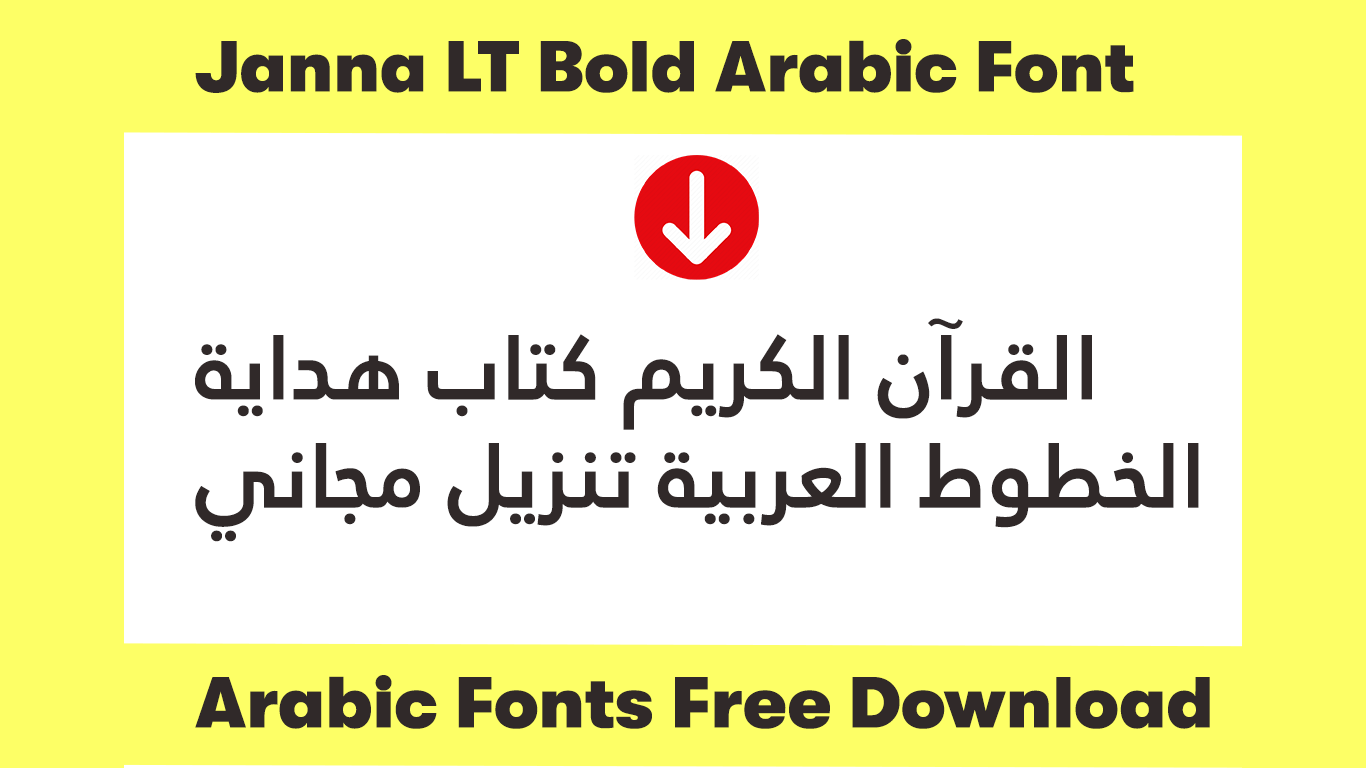
Janna LT Bold Font - Free Download for Quran and Arabic Content
Janna LT Bold is a professional Arabic typeface specifically designed for Quran printing and Islamic publications. This font has become the standard choice for religious content creators, Islamic websites, and digital Quran applications due to its exceptional clarity and respectful aesthetic. The typeface combines traditional Arabic calligraphy principles with modern digital requirements, making it equally suitable for screen display and print production.
The Janna font family was developed by Linotype Foundry to address the growing need for high-quality Arabic typography in religious and educational materials. The Bold variant offers enhanced visibility for headings, titles, and emphasis text while maintaining the elegant characteristics that make this typeface appropriate for sacred content. Content creators working with Islamic themes consistently choose this font for its balance of readability and cultural appropriateness.
Font Origins and Design Philosophy
The Janna typeface family draws inspiration from classical Arabic calligraphy traditions while incorporating contemporary design elements. The name "Janna" references the Islamic concept of paradise, reflecting the font's intended use for religious and spiritual content. Designers spent considerable time researching traditional Quran manuscripts to ensure the typeface respects cultural and religious sensitivities.
The Bold weight was specifically engineered to provide emphasis without appearing aggressive or inappropriate for religious contexts. Stroke weights were carefully calibrated to maintain harmony with the regular variant while providing sufficient contrast for hierarchical typography. The design team prioritized legibility at small sizes, recognizing that Quran texts often require compact formatting.
Unlike decorative Arabic fonts that prioritize ornamental flourishes, Janna LT Bold focuses on clean, respectful presentation. The letterforms maintain proper proportions according to Islamic calligraphy traditions while ensuring modern digital compatibility. This thoughtful approach has earned the font widespread acceptance within Islamic scholarly communities.
Technical Specifications
Understanding the technical characteristics of Janna LT Bold helps users implement the font effectively across different platforms and applications. The specifications reflect professional typographic standards.
Font Family: Janna LT
Weight: Bold
Designer: Linotype Design Studio
Foundry: Linotype (Monotype Imaging)
Script Support: Arabic, Urdu, Persian (Farsi), Kurdish
Unicode Coverage: Arabic U+0600–U+06FF, Arabic Supplement, Arabic Extended-A
File Formats: TTF, OTF
Hinting: Optimized for screen display
Kerning: Arabic-specific pair adjustments
OpenType Features: Contextual alternates, ligatures, positional forms
The font includes comprehensive OpenType features that ensure proper Arabic text rendering. Contextual alternates automatically adjust letterforms based on position within words. Required ligatures combine specific letter combinations into traditional forms. The font engine handles initial, medial, final, and isolated forms without user intervention.
Primary Applications and Use Cases
Janna LT Bold serves diverse applications within Islamic content creation and religious education. The font's versatility extends beyond traditional Quran printing into modern digital media.
Digital Quran Applications
Mobile Quran applications utilize Janna LT Bold for verse headings, surah titles, and emphasis text. The font maintains clarity across different screen sizes and resolutions common in smartphones and tablets. Application developers appreciate the font's small file size relative to its comprehensive character coverage.
Quran websites implement this typeface for online reading platforms and audio-synched text displays. The bold weight effectively distinguishes chapter headings from verse text. Responsive web design implementations maintain readability across desktop and mobile browsers.
Electronic Quran devices (digital mushaf) incorporate this font for their display systems. The typeface supports the complex layout requirements of Quranic text including proper verse numbering and diacritical mark positioning.
Islamic Educational Content
Islamic schools and madrasas use Janna LT Bold for educational materials and classroom resources. The font appears in textbooks, workbooks, and presentation slides covering Quranic studies, Hadith, and Islamic jurisprudence. Teachers appreciate the font's clarity for student reading materials.
Online Islamic courses implement this typeface for video subtitles and on-screen text. The bold weight ensures visibility in compressed video formats while maintaining cultural appropriateness. Educational YouTube channels consistently choose this font for Arabic and Urdu text overlays.
Islamic mobile learning applications incorporate the font for interactive lessons and quizzes. The typeface supports gamified learning interfaces without compromising educational gravitas.
Religious Publications and Print Media
Islamic book publishers rely on Janna LT Bold for book titles, chapter headings, and cover designs. The font appears in publications covering Tafsir (Quran commentary), Seerah (Prophet biography), and Islamic theology. Print quality remains consistent across different paper stocks and printing methods.
Magazine and periodical publishers use this font for article headlines and feature titles. The typeface complements editorial layouts while respecting religious content sensitivities. Annual Islamic publications such as Hajj guides and Ramadan planners incorporate this font for section headings.
Poster and banner designers select Janna LT Bold for mosque announcements, event promotions, and religious lecture advertisements. The font maintains impact at large sizes required for outdoor display.
Social Media and Digital Content
Islamic content creators on Instagram, Facebook, and TikTok use Janna LT Bold for quote graphics and inspirational posts. The font effectively presents Quranic verses and Hadith translations with appropriate visual respect. Content creators report high engagement rates for posts utilizing this typeface.
YouTube Islamic channels implement this font for video thumbnails, title cards, and end-screen information. The bold weight captures viewer attention while maintaining religious dignity. Scholars and speakers use this font for presentation slides during online lectures.
WhatsApp and Telegram Islamic groups share images and documents using this font for important announcements and daily reminders. The typeface ensures readability across different device types and screen qualities.
Language and Script Support
Janna LT Bold provides comprehensive support for languages utilizing Arabic script, extending its utility beyond Standard Arabic.
Classical Arabic support includes all letters required for Quranic text including optional diacritical marks (Tashkeel) for pronunciation guidance. The font properly handles special Quranic characters such as small seen, small meem, and sajda markers. Vowel marks (Fatha, Kasra, Damma) position correctly above and below base letters.
Modern Standard Arabic coverage encompasses contemporary vocabulary and grammatical constructions. The font handles hamza variations correctly, including seated hamza and hamza on the line. Madda markings appear with proper length and positioning.
Urdu language support includes all extended characters such as peh, cheh, zheh, gaf, and various nukta combinations. The font accommodates Urdu-specific ligatures and letter combinations. Nastaleeq-style rendering preferences are respected where possible within the font's design constraints.
Persian (Farsi) compatibility ensures proper rendering of additional letters including peh, cheh, zheh, and gaf variants specific to Persian orthography. The font supports Persian poetry formatting requirements including proper alignment and spacing conventions.
Kurdish Sorani script coverage expands the font's utility for regional Islamic content in Kurdish-speaking communities. Additional character support includes variations required for minority languages using Arabic script.
Installation and Implementation Guide
Proper installation ensures optimal performance across different operating systems and applications. Following these procedures prevents common technical issues.
Windows Installation Process
Windows users can install Janna LT Bold through multiple methods. The standard installation involves right-clicking the font file and selecting Install from the context menu. This method requires administrative privileges on some system configurations.
Alternative installation through Control Panel provides access to font management features. Users navigate to Appearance and Personalization, then Fonts, and drag the font file into the system folder. This method allows preview before installation.
Windows 10 and 11 users benefit from the Settings application approach. Navigating to Personalization, then Fonts, provides a modern interface for installation and management. The preview function displays sample text before system integration.
After installation, applications require restart to recognize the new font. Microsoft Office applications, Adobe Creative Suite, and web browsers access the font immediately upon relaunch. System-wide availability ensures consistent appearance across different software.
macOS Installation Procedure
Macintosh users install Janna LT Bold through Font Book application. Double-clicking the font file opens the preview window with an Install Font button. Font Book validates the font file for corruption before installation.
Manual installation to user Library provides control over font accessibility. Copying files to ~/Library/Fonts makes the font available to the current user only. System-wide installation requires placement in /Library/Fonts with administrator authentication.
Font Book allows users to validate, enable, and disable fonts without complete uninstallation. This feature helps manage large font collections and troubleshoot application-specific issues. Users can create custom collections for project organization.
Applications typically recognize newly installed fonts without system restart. Professional design software including Adobe Illustrator and InDesign access the font immediately. Web browsers may require cache clearing to display web fonts properly.
Android Device Installation
Android users require third-party applications for font installation due to system limitations. Font management applications such as iFont, zFont, or HiFont provide installation interfaces. These applications require storage permissions to access downloaded font files.
The installation process involves importing the font file through the management application and applying it as a system font. Some devices require restart for complete activation. Manufacturer-specific interfaces may vary slightly in procedure.
Video editing applications including CapCut and VN Video Editor may offer direct font import without system-wide installation. This method limits font availability to specific applications but avoids system modification. Users should check individual application documentation for font import procedures.
Android 12 and newer versions implement additional security restrictions that may affect font installation. Users should ensure their font management applications are updated for compatibility with current Android versions.
iOS Device Installation
iPhone and iPad users install fonts through the iFont application or similar App Store downloads. The process involves downloading the font file, importing it into the font management application, and installing a configuration profile through Settings.
Configuration profile installation requires navigating to Settings, then General, then VPN and Device Management. Users must approve the font profile to complete installation. This security measure ensures users intentionally authorize font modifications.
Some applications including VN Video Editor and LumaFusion offer built-in font import that bypasses system installation. This method stores fonts within application sandboxes for immediate use. The limitation restricts font availability to specific applications.
iOS updates may invalidate previously installed fonts requiring reinstallation. Users should maintain backup copies of font files for quick restoration. iCloud backup does not typically include user-installed fonts.
Design Best Practices
Effective use of Janna LT Bold requires attention to typographic principles specific to Arabic script and religious content.
Size selection significantly impacts readability and visual appropriateness. For Quran text, body copy typically ranges from 16 to 20 points depending on medium. Headings and titles benefit from 24 to 36 point sizes for emphasis. Digital displays may require larger sizes due to pixel density variations.
Line spacing should accommodate the tall ascenders and deep descenders common in Arabic script. Increasing default line spacing by 20 to 30 percent prevents visual crowding. This adjustment maintains the spiritual calm appropriate for religious reading.
Color selection should respect cultural preferences while ensuring accessibility. Dark text on light backgrounds provides optimal readability for extended reading. Religious contexts often favor green, gold, or deep blue as accent colors reflecting Islamic artistic traditions.
Text alignment for Arabic content should consistently use right alignment. Mixed Arabic and English content requires careful attention to directional formatting. Bi-directional text algorithms in modern software handle most situations automatically.
Comparison with Alternative Fonts
Understanding how Janna LT Bold compares to similar typefaces helps users make informed selection decisions.
Scheherazade New offers similar Quranic optimization with a more traditional calligraphic approach. Janna LT Bold provides a more contemporary aesthetic suitable for modern digital applications. Both fonts maintain excellent readability but serve slightly different design intentions.
Amiri Quran focuses specifically on classical text reproduction with extensive ligature support. Janna LT Bold offers broader application flexibility beyond traditional Quran formatting. Users prioritizing historical accuracy may prefer Amiri, while those needing versatility may choose Janna.
Traditional Kufic fonts provide decorative alternatives for headings and artistic applications. Janna LT Bold maintains superior readability for body text and extended reading. The choice depends on specific project requirements and audience expectations.
System default Arabic fonts such as Arial Unicode or Times New Roman Arabic lack the specialized optimization of Janna LT Bold. Professional Islamic content benefits from the intentional design decisions embedded in dedicated typefaces.
Legal Considerations and Licensing
Janna LT Bold is distributed under specific licensing terms that users must understand for compliant implementation.
The font is typically available for free download for personal and educational use. Commercial applications may require license verification depending on distribution source. Users should confirm licensing status before implementing in revenue-generating projects.
Redistribution of the font file is generally restricted to prevent unauthorized distribution and version fragmentation. Users should direct others to official download sources rather than sharing font files directly. This practice ensures recipients obtain authentic, uncorrupted files.
Modification of the font file including outline editing or format conversion requires explicit permission from the rights holder. Creating derivative works based on the typeface design may infringe intellectual property rights.
Web font implementation through @font-face embedding may require specific licensing depending on traffic volume and commercial status. Users should consult current licensing documentation for web implementation guidelines.
Technical Troubleshooting
Users may encounter specific issues when implementing Janna LT Bold. Understanding solutions prevents workflow disruption.
Font not appearing in application font lists typically requires software restart. Some applications cache available fonts at launch and do not detect new installations until relaunch. Clearing application preferences may resolve persistent issues.
Arabic text displaying incorrectly as separate letters or incorrect forms indicates missing OpenType support. Applications must support Arabic shaping engines to properly render connected script. Updating applications to current versions often resolves these issues.
Diacritical marks appearing in wrong positions or overlapping base letters suggests font file corruption. Re-downloading from official sources typically resolves display issues. Verifying file checksums ensures download integrity.
Printing problems including missing characters or incorrect spacing may indicate printer driver limitations. Updating printer firmware or using alternative output methods such as PDF export can circumvent these restrictions.
Conclusion
Janna LT Bold represents a significant achievement in Arabic typeface design, successfully bridging traditional calligraphy principles with contemporary digital requirements. The font serves diverse applications from sacred Quran printing to social media content creation while maintaining cultural and religious appropriateness.
Its widespread adoption within Islamic content creation communities testifies to its effectiveness and reliability. The typeface enables creators to produce professional-quality materials without compromising spiritual values or aesthetic standards.
As digital Islamic content continues expanding globally, quality typography tools like Janna LT Bold become increasingly essential. The font supports meaningful communication of religious teachings while respecting the visual traditions of Islamic civilization.
Users implementing this font contribute to a visual culture that honors both heritage and innovation. The careful balance struck by Janna LT Bold serves as a model for culturally-sensitive typeface design in an interconnected world.