
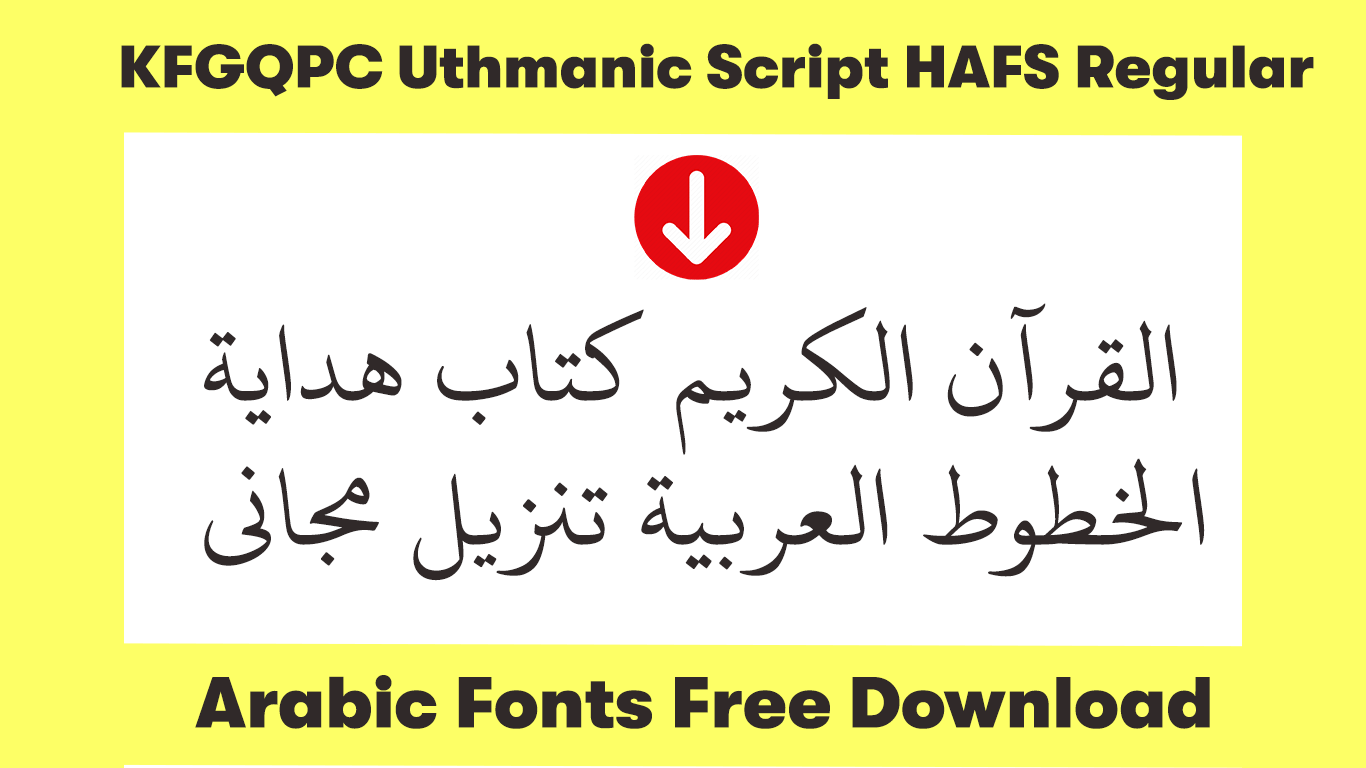
KFGQPC Uthmanic Script HAFS Regular Font - Authentic Quran Typography
KFGQPC Uthmanic Script HAFS Regular is a specialized Arabic typeface designed specifically for digital Quran representation following the Uthmani script tradition. This font represents one of the most authentic digital reproductions of the Quranic text as preserved in the Medina mushaf, making it essential for Islamic applications, Quran websites, and digital publishing projects that require scriptural accuracy.
The King Fahd Glorious Quran Printing Complex (KFGQPC) developed this typeface to ensure that digital Quran presentations maintain the visual integrity of the official printed mushaf. The HAFS variant follows the Hafs an Asim recitation tradition, which is the most widely followed qira'ah (recitation method) in the Islamic world. This specific combination of script style and recitation tradition makes the font invaluable for developers and content creators working on Quranic projects.
Historical Significance and Development Background
The Uthmani script derives its name from the third Caliph Uthman ibn Affan, who commissioned the standardization of the Quranic text during the early Islamic period. This script became the foundation for Quranic preservation and transmission across centuries. The KFGQPC undertook the monumental task of digitizing this tradition to serve contemporary digital needs while maintaining historical authenticity.
The King Fahd Complex, established in Medina, Saudi Arabia, has been at the forefront of Quranic printing technology since 1985. Their printed mushaf has become the global standard for Quranic publication, distributed to millions of Muslims worldwide. The digital font project extended this standardization into electronic formats, ensuring consistency between print and digital representations.
Development of the digital typeface required extensive collaboration between Islamic scholars, calligraphers, and font engineers. Each letterform was meticulously crafted to match the approved mushaf specimens. The process involved analyzing thousands of character combinations to ensure proper contextual rendering across all Quranic verses.
The HAFS designation indicates compliance with the recitation tradition transmitted by Hafs from his teacher Asim al-Kufi. This qira'ah dominates Quranic recitation across the Muslim world, particularly in Africa, Asia, and parts of the Middle East. The font includes specific orthographic features that support proper recitation according to this tradition.
Technical Specifications and Font Architecture
Understanding the technical foundation of KFGQPC Uthmanic Script HAFS Regular enables developers to implement the font effectively across diverse platforms and applications.
Font Name: KFGQPC Uthmanic Script HAFS Regular
Developer: King Fahd Glorious Quran Printing Complex
Script Style: Uthmani (Medina Mushaf Standard)
Qira'ah: Hafs an Asim
Unicode Coverage: Arabic U+0600–U+06FF, Arabic Supplement, Arabic Extended-A and B
File Formats: TTF, OTF, WOFF for web implementation
OpenType Features: Required ligatures, contextual alternates, Quranic annotations
Hinting: Optimized for screen rendering at various sizes
The font architecture incorporates sophisticated OpenType programming that handles the complex requirements of Quranic text. Automatic contextual substitution ensures letters appear in correct forms based on position within words. Special ligatures combine specific letter sequences according to traditional mushaf conventions.
Quranic annotation marks receive particular attention in the font design. Sajda markers, pause signs (waqf), and verse numbers position automatically with proper spacing relative to main text. These features reduce manual formatting requirements for developers implementing Quranic content.
Primary Applications and Implementation Areas
KFGQPC Uthmanic Script HAFS Regular serves specific applications where Quranic authenticity and accuracy are paramount considerations.
Digital Quran Applications and Software
Mobile Quran applications represent the largest implementation category for this font. Developers choose this typeface to ensure their applications display Quranic text identically to the recognized printed mushaf. The font supports both portrait and landscape reading orientations common in mobile devices.
Quran memorization applications utilize the font for its clear distinction between similar letters, crucial for accurate memorization. Tafsir applications combine the font with commentary text, requiring careful typographic hierarchy. Audio-synched applications align the font with recitation timing for word-by-word highlighting.
Desktop Quran software for Windows, macOS, and Linux platforms implement this font for offline reading capabilities. These applications often include search functionality, bookmarking, and note-taking features that interact with the font rendering.
Web-based Quran readers deploy this font through @font-face embedding or JavaScript font loaders. The WOFF format ensures efficient loading while maintaining display quality across browsers.
Islamic Websites and Online Platforms
Quran websites implement this font to provide authentic reading experiences for visitors. Major Islamic portals license or implement this font for their Quranic sections. The consistent appearance builds user trust in the accuracy of presented content.
Islamic educational platforms integrate the font into lesson materials and interactive exercises. Students learn to recognize Quranic script in its standard form, facilitating transition to printed mushaf reading. Assessment systems use the font to test recognition and recitation skills.
Research and academic websites utilize this font for scholarly articles discussing Quranic text. Proper representation of source material maintains academic standards for Islamic studies publications.
Electronic Publishing and Digital Libraries
E-book publishers specializing in Islamic content license this font for Quran editions. EPUB and PDF formats maintain font embedding to preserve text appearance across different reading devices. Digital libraries include Quran manuscripts and commentaries using this font for searchable text layers.
Academic databases implement the font for Quranic citation and reference systems. Standardized encoding ensures accurate text searching and comparison across different sources.
Print and Production Applications
While designed for digital implementation, the font serves pre-press workflows for Islamic publishing. Desktop publishing applications import the font for book design, poster creation, and educational material production. Print-on-demand services utilize the font for customized Quran products.
Large-format printing for mosque displays and Islamic center decorations employs this font for professional results. The scalable outlines maintain quality at extreme sizes required for banners and wall displays.
Distinctive Features and Design Characteristics
Several design elements distinguish KFGQPC Uthmanic Script HAFS Regular from general-purpose Arabic fonts.
Authentic Letterform Construction
The font reproduces specific letter shapes as approved by the KFGQPC for their official mushaf. Subtle curve variations and proportion relationships match the printed standard exactly. This authenticity supports religious confidence in digital representations.
Baseline alignment follows traditional mushaf conventions rather than modern typographic standards. Certain letters extend below the baseline in specific ways that distinguish this script from contemporary Arabic fonts.
Quranic Annotation Support
The font includes comprehensive support for Quranic reading marks and symbols. Sajda markers appear as specific symbols indicating prostration verses. Waqf signs indicate recommended and obligatory stopping points during recitation.
Verse number symbols follow the traditional medallion style rather than modern numerals. Juz and hizb markers provide structural navigation aids for readers.
Diacritical Mark Positioning
Vowel marks (harakat) position with exceptional precision relative to base letters. Stacking multiple marks on single letters follows traditional placement rules. The font handles complex combinations that occur in Quranic text but rarely in modern Arabic.
Shadda (gemination mark) combinations with vowel marks receive special attention. The font prevents overlapping while maintaining clear visual distinction between marks.
Language Support and Character Coverage
While designed primarily for Quranic Arabic, the font provides support for related linguistic requirements.
Classical Arabic coverage encompasses all letters and marks required for Quranic text including rare letter combinations. The font properly handles words that appear only once in the entire Quran (mufradat). Special characters for pause and continuation marks integrate seamlessly with main text.
Modern Standard Arabic compatibility ensures utility for contemporary Islamic content. While optimized for Quranic representation, the font functions adequately for general Arabic text when stylistic consistency is desired.
Transliteration support includes Latin characters for mixed-content applications. This feature supports educational materials that combine Arabic script with phonetic guides.
Installation and Implementation Procedures
Proper installation ensures the font functions correctly across different operating systems and applications.
Windows Platform Installation
Windows users install the font through standard system procedures. Right-clicking the font file and selecting Install adds the font to system fonts. Administrative privileges may be required depending on system configuration.
Font installation through Control Panel provides access to preview functions. Users can verify the font appearance before system-wide activation. The preview displays sample Quranic text demonstrating special features.
Professional design applications including Adobe InDesign and Illustrator access the font immediately after installation. Microsoft Office applications require restart to recognize newly installed fonts.
Web developers implementing the font locally should verify file paths in CSS declarations. The font family name must match exactly for proper loading.
macOS Installation Process
Macintosh users install through Font Book application. Double-clicking the font file opens the preview window with installation options. Font Book validates the file for corruption before installation.
Manual installation to user or system Library provides flexibility for multi-user systems. Font Book management tools enable activation and deactivation without uninstallation.
Professional publishing applications on macOS recognize the font immediately. Web development environments may require font cache clearing for proper recognition.
Web Implementation Methods
Web developers implement this font through several technical approaches. Self-hosting requires proper font file formats including WOFF2 for modern browsers and fallback formats for legacy support.
Content Delivery Networks may offer hosted versions of this font for convenient implementation. Developers should verify license terms for CDN usage before implementation.
JavaScript font loaders provide advanced loading control for web applications. These tools manage font loading states and fallback behaviors during page load.
CSS font-display properties optimize loading behavior. The swap value ensures text visibility during font loading, improving perceived performance.
Mobile Application Integration
Mobile developers embed the font within application packages for offline availability. iOS applications include font files in application bundles with proper Info.plist registration.
Android applications package fonts in assets directories for runtime loading. Some applications implement dynamic font downloading to reduce initial application size.
Cross-platform frameworks including React Native and Flutter support custom font integration. Platform-specific configuration ensures consistent rendering across iOS and Android.
Best Practices for Implementation
Effective use of KFGQPC Uthmanic Script HAFS Regular requires attention to specific implementation considerations.
Font sizing should accommodate the detailed marks and annotations common in Quranic text. Minimum sizes of 18 pixels ensure legibility of diacritical marks on standard displays. Larger sizes improve readability for extended reading sessions.
Line spacing requires adjustment beyond default settings. The tall ascenders and deep descenders of Arabic script need additional vertical space. Increasing line height by 50 to 75 percent prevents visual crowding.
Text direction must consistently follow right-to-left orientation. Mixed Arabic and English content requires careful attention to bi-directional text handling. Modern browsers and applications manage directionality automatically with proper markup.
Color selection should prioritize readability over decoration. Dark text on light backgrounds provides optimal contrast for extended reading. Religious contexts may favor specific color schemes that maintain respectful presentation.
Comparison with Alternative Quran Fonts
Understanding alternatives helps developers select appropriate typefaces for specific applications.
Scheherazade New offers excellent Quranic support with different aesthetic characteristics. The font follows different calligraphic traditions while maintaining Unicode compliance. Developers may choose based on specific visual requirements.
Amiri Quran focuses on classical book typography with extensive feature support. The font excels in academic and scholarly applications requiring detailed annotation. KFGQPC Uthmanic Script prioritizes mushaf authenticity over general typography.
Traditional Naskh fonts provide alternatives for applications requiring different stylistic approaches. These fonts may better suit certain regional preferences or historical reproductions.
System default fonts lack the specialized optimization for Quranic text. General Arabic fonts do not include Quranic annotations and may misrepresent specific letterforms.
Technical Troubleshooting and Solutions
Developers may encounter specific issues when implementing this font.
Font not displaying in applications typically indicates installation problems or application caching. Restarting applications after font installation resolves most issues. Clearing font caches may be necessary for persistent problems.
Incorrect letter connectivity suggests missing OpenType support in the application. Updating to current application versions often resolves shaping issues. Web applications should verify JavaScript libraries support Arabic shaping.
Annotation marks appearing incorrectly usually indicates font file corruption. Re-downloading from official sources ensures file integrity. Verifying checksums confirms proper download completion.
Web font loading failures may result from incorrect file paths or server configuration. CORS headers must allow font loading from web domains. File permissions should enable public access to hosted font files.
Licensing and Usage Rights
KFGQPC Uthmanic Script HAFS Regular operates under specific licensing terms that users must understand.
The King Fahd Complex generally permits free use for non-commercial religious and educational purposes. This policy supports widespread Quran accessibility across Muslim communities.
Commercial applications may require explicit licensing from KFGQPC. Developers should contact the Complex directly for commercial usage permissions. License terms may include attribution requirements or usage restrictions.
Redistribution of font files is typically restricted to prevent unauthorized distribution. Users should direct others to official download sources rather than sharing files directly.
Modification of font files is not permitted without authorization. Creating derivative works may infringe intellectual property rights of the KFGQPC.
Conclusion
KFGQPC Uthmanic Script HAFS Regular represents a significant achievement in digital Quranic preservation. The font successfully translates centuries of calligraphic tradition into functional digital typography while maintaining the religious authenticity essential for sacred text representation.
Its widespread adoption across Quran applications, Islamic websites, and educational platforms demonstrates its effectiveness and reliability. The font enables Muslims worldwide to access Quranic text in its recognized standard form through digital devices.
As digital Islamic resources continue expanding, quality typography tools like this font become increasingly vital. The careful balance between historical preservation and technical functionality serves as a model for culturally-sensitive digital development.
Developers and content creators implementing this font participate in a global effort to make Quranic knowledge accessible while respecting traditional forms. The KFGQPC's commitment to standardization benefits the entire Muslim community through consistent, authentic text representation.